Events are expensive. A booth, travel, and a team's time add up fast, and the entire return depends on one thing: what happens to the people you meet. Yet most collected contacts never get a real follow-up. Cards pile up, memories fade, and by the time anyone sorts through the stack, the warm conversation has gone cold.
The fix is not collecting more contacts. It is capturing each one properly, with the context that makes follow-up specific, and moving it into your system before you leave the venue. This playbook runs in two halves: what happens at the booth — staffing, the opening seconds, the capture itself, the next-step ask — and what happens after it.
Why leads leak after events
The gap between meeting someone and following up is where event ROI disappears. Three things cause it.
The contact is captured but the context is not
A name and email tell you nothing about what the person needed. Without a note on the conversation, your follow-up is a generic template, and it reads like one.
The data never leaves the booth
Paper cards and scribbled notes sit in a bag for days. More than 60% of collected business cards end up misplaced within a month, and a lead you cannot find is a lead you did not capture.
The follow-up window closes
Interest is highest in the first 48 hours. Miss that window and you are competing with every other vendor the person met, plus the inbox that piled up while they were away.
Staff the booth so nobody gets missed
Most leads that leak at a trade show never make it into anyone's hands in the first place. Someone walks past an unattended booth, or waits behind a demo that is running long, or talks to whoever happens to be free and then leaves without being captured. Coverage is a staffing problem before it is a tooling problem, so decide the roles before the hall opens.
- 1
Greeter
Stands at the edge of the booth, facing the aisle, and opens conversations. Never seated, never on a phone. Their job is to qualify quickly and hand off, not to demo.
- 2
Demo
Takes the qualified conversations and shows the product. Expect these to run long — that is fine, as long as the greeter is still catching the aisle while it happens.
- 3
Capture
Whoever had the conversation captures the lead before the next one starts. Not later, not from a pile at the end of the day. If a handoff happened, the person who closes the conversation owns the capture.
- Rotate in shifts so the booth is never empty and never so crowded that visitors read it as busy and walk on.
- Give every captured lead one named owner at the moment of capture, so no contact is left for "someone" to pick up.
- Brief the team on the same opener and the same qualifying questions, so a lead gets the same experience whoever they meet.
- Agree on what a real lead is before the show, so the pile you review that evening is not padded with badge-swipers who wanted a pen.
This scales down as well as up. A two-person booth still needs one person facing the aisle while the other is in a conversation. If you are running the stand alone, work in shorter conversations and capture between each one. Teams who do this every season — event planners and manufacturers working a season of trade shows — tend to standardize the roles once and reuse them show after show.
The first 15 seconds at the booth
A visitor decides whether to stop before you finish your first sentence. That gives you about fifteen seconds to say who you help and what you solve, in plain language, without a feature list. Lead with the problem you remove, not with the product name.
A 15-second booth opener
Hi — are you [role] side or [other role] side?

We work with [who you help], usually when [the specific problem]. Most of them were doing [the painful old way] before.

What brought you to the show?
Then stop talking. The opener exists to earn a question, and the question is where qualification actually happens. Ask open-ended ones — what they are trying to solve, what they use today, what would have to change — rather than yes/no ones that end the exchange. Aim to listen far more than you talk; roughly four-fifths of a good booth conversation is the visitor explaining their situation.
- Do not open with "can I help you?" — it invites "just looking" and ends there.
- Do not launch the demo before you know what the person came for. You will demo the wrong half.
- Do not stand behind the table with your arms folded. Face the aisle, stay standing, keep your hands free.
- Do not let food, phones or laptop screens sit between you and the aisle.
The end of the conversation matters as much as the start. Fumbling for a paper card, or asking someone to type their email into your phone, is where the energy drains out. Have your QR card ready on your screen so the exchange takes one scan: they open your card in their browser and save you, no app to install on their side. That is also the cleanest way to end a conversation you want to continue.
The three ways to capture a lead
Trade show lead capture comes down to three practical methods, and the best booths use more than one depending on the moment. If you want the tooling comparison rather than the technique, the event lead capture tools roundup ranks what is available in 2026.
1. Scan their card
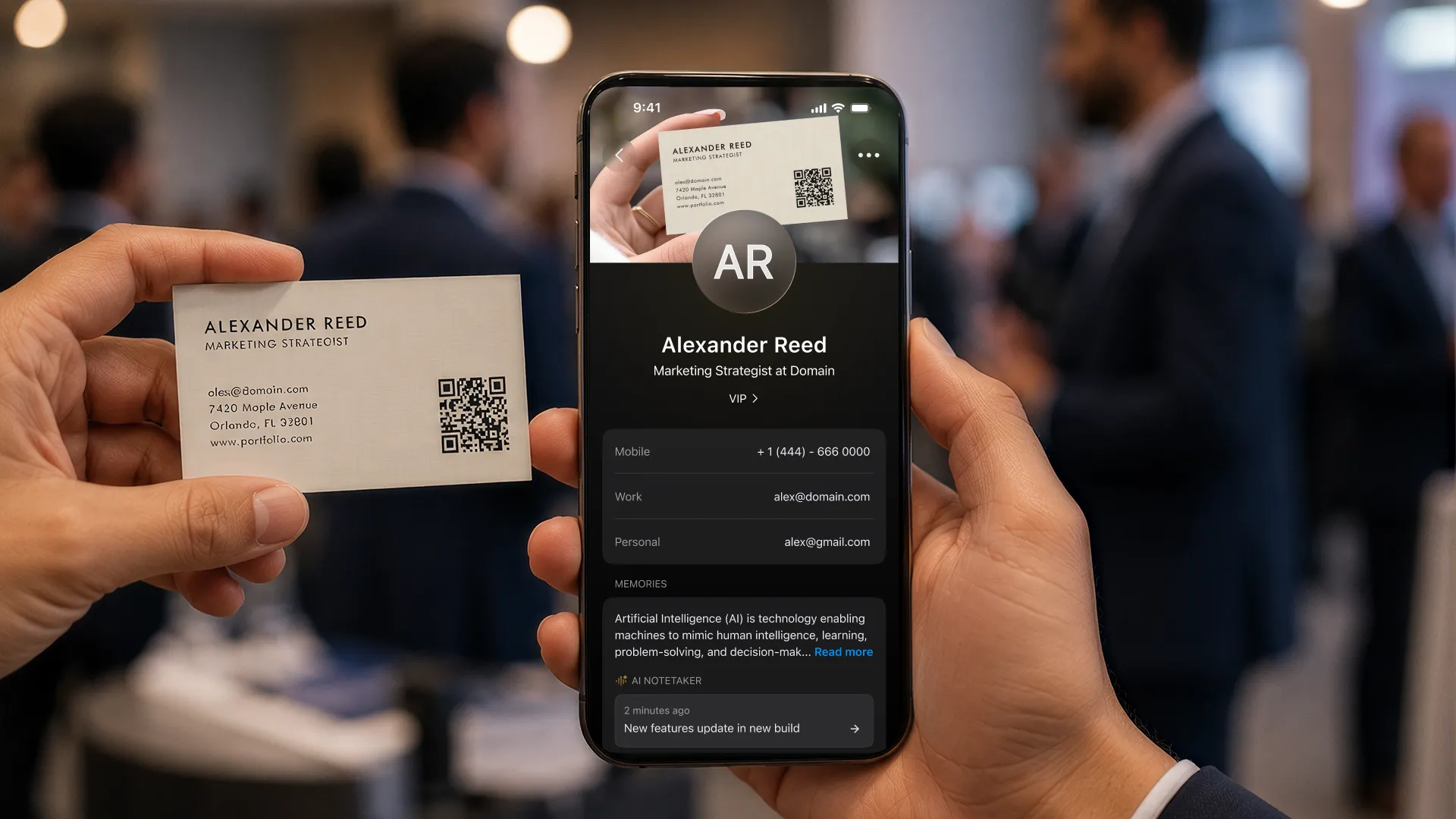
When someone hands you a paper card, scan it with an AI scanner that extracts name, company, title, email, and phone into a clean contact in seconds. This beats a manual entry every time and preserves the original card image so you can check it later. If a rush comes through and you end up with a stack anyway, you can scan the stack in bulk afterwards — see scanning business cards at a conference for how that works, and the scanner app comparison for how the options differ.
2. Share your digital card and let them save you
Show a QR code and let the other person open your card and save your details in their browser, with no app required. This works well at a booth, where a stand with your QR turns every passerby into a possible contact.
3. Exchange digitally, both directions
The strongest capture is mutual: they get your card, you get theirs, and both land as contacts you can act on. A two-way exchange means neither side depends on remembering to follow up from a photo.
None of this requires the show's badge hardware. A card scanner and a QR card work in the aisle, at the coffee stand and at dinner, which is where a good share of the real conversations happen anyway.
Capture the context, not just the contact
This is the step almost everyone skips, and it is the one that turns a contact into a conversation. The moment you capture someone, add the context while it is fresh.
- Record a voice note the second you step away: what they needed, what you promised, what stood out.
- Tag the contact with the event, so you can pull up everyone you met in one place afterward.
- Note the next step and when it should happen, not just that a follow-up is due.
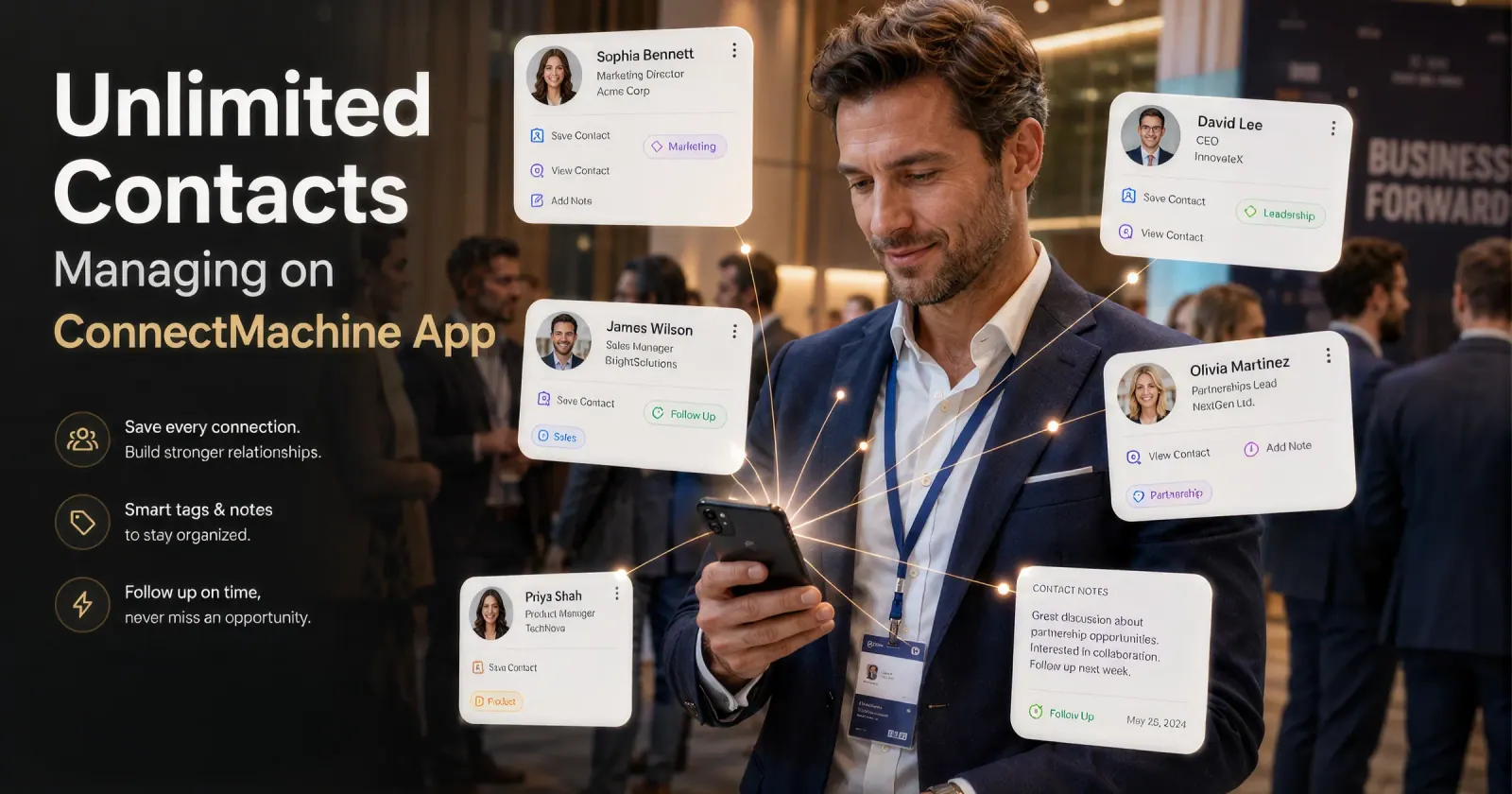
With ConnectMachine you can attach voice memos and notes to every contact, then ask the AI Concierge in plain language later, for example who you met at a specific booth or who mentioned a particular need. A pile of names becomes something you can actually query.
Ask for the next step, not the signature
Closing at a trade show almost never means closing a deal on the floor. The visitor is three aisles into a day of booths, usually without the authority or the time to decide anything. What you are actually closing is the next step — and a booked, specific one beats a vague promise to "stay in touch" by a wide margin.
- Qualify early enough that you know whether a next step is worth asking for. A polite exit is a better outcome than a meeting neither side wants.
- Name the next action and the date out loud at the booth: a call on a specific day, a demo for a named team, a sample sent to a named address.
- Write the commitment into the note on the contact, in their words, before the next conversation starts.
- Skip the pressure. A hard close at a booth costs you the follow-up you would otherwise have earned — the visitor stops replying rather than saying no.
The next-step ask
So if I've got this right: [their situation, in their words], and the part that actually hurts is [the specific problem].

The useful next step is probably [specific action] — that takes [realistic time] and I'd want [who else should be there] on it.

Does [day] or [day] work better for you? I'll send the invite tonight while this is fresh.
Then capture it immediately, with the commitment attached. A contact that says "demo for the ops team, Thursday, they run three plants on spreadsheets" is a lead. A contact that says nothing is a name.
Get every lead into your system the same day
A captured lead that never reaches your pipeline is still a lost lead. Close the loop before you leave the venue.
- Run an end-of-day booth review as a team, while the conversations are still fresh: read through the day's captures, fix scan errors and typos, and fill in the notes anyone was too busy to finish.
- Drop the leads that were never real. A shorter, honest list is worth more to whoever works it next week.
- Push new contacts to your CRM, by direct sync on a paid plan or a CSV export on any plan.
- Automate the routing with a Zapier connection so new contacts flow into the tools your team already runs, across 5,000+ apps.
- Assign owners and first follow-up dates so nothing waits for someone to notice it.
Doing this each evening rather than on the flight home matters more than it sounds. A scan error you catch the same day is a contact; the same error found a week later is a dead email address attached to a conversation nobody remembers.
Use the 48-hour window
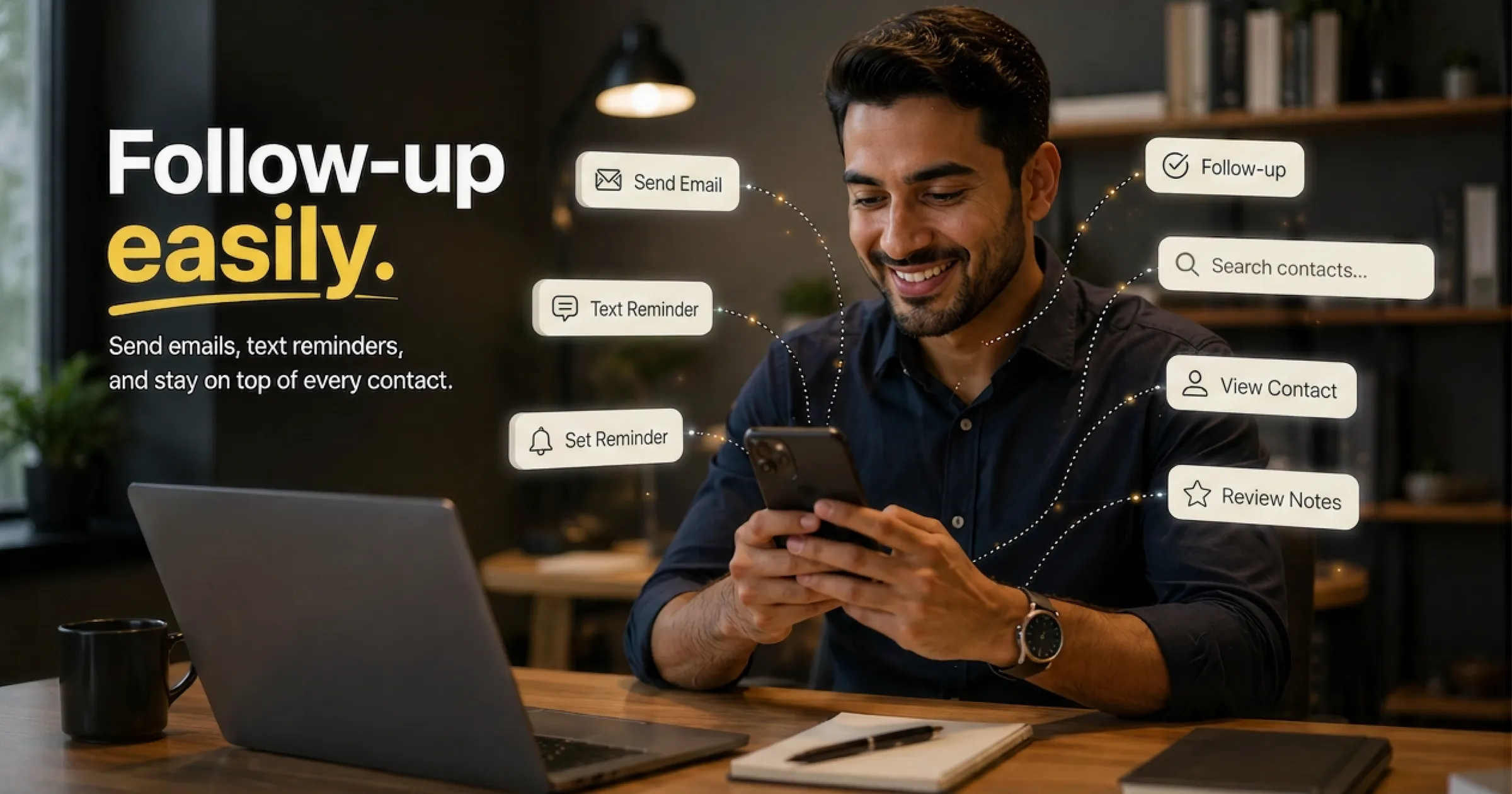
Send the first follow-up within one to two days, and make it specific to the conversation. A message that references what you actually discussed outperforms any polished template that could have been sent to anyone. For the longer version — timing, sequencing, and what to write when there was no clear next step — see how to follow up after a networking event.
Simple post-event follow-up
Hi [name], great to meet you at [event]. You mentioned [the specific thing they cared about], so I wanted to follow up with [the relevant next step]. Would [day] work for a short call? Either way, here is my card so you have my details: [card link].