

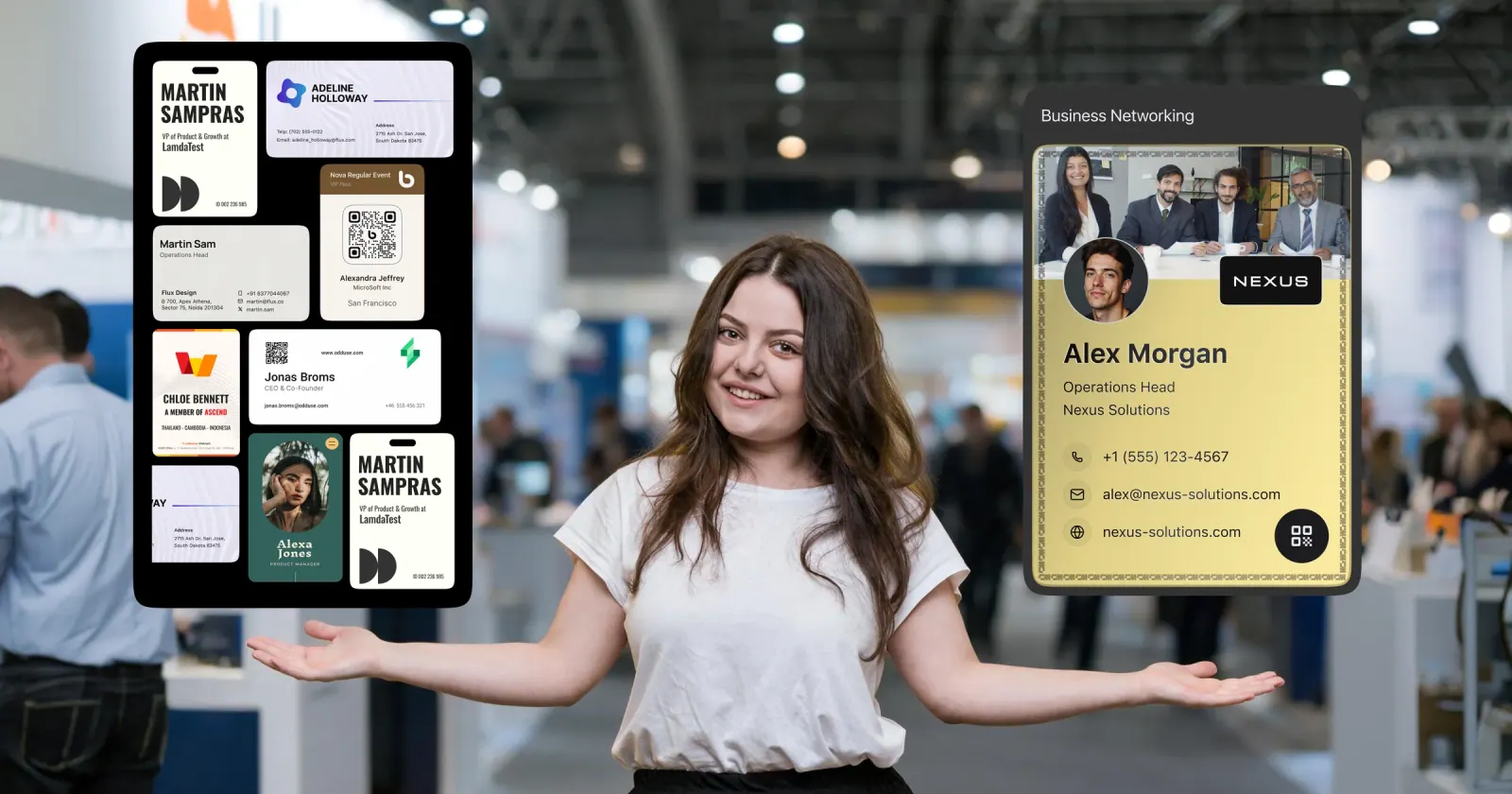
Roughly 88% of paper business cards are thrown away within a week of being received. That single statistic reframes the paper versus digital question: the problem is not how your card looks in someone's hand, it is what happens to your details afterwards.
This guide compares paper and digital business cards on the things that actually matter: cost per useful contact, whether your details survive the week, what happens when your job title changes, and the environmental bill. We will also be honest about the scenarios where a printed card still wins, because there are some.
If you just want the short version: digital wins on cost, retention, updates, and sustainability. Paper wins on ceremony and on the rare occasions when a phone is the wrong object to hold. Most professionals end up carrying both, with digital as the default.
The comparison at a glance
- 1
Cost
Premium paper cards run $50-200 per 500, and you pay again for every reprint. A digital card costs nothing per share, and free tiers cover the core workflow.
- 2
Retention
Studies show 63% of received paper cards are never entered into any contact system. A scanned digital card saves straight to the recipient's phone.
- 3
Updates
A new title or number makes every printed card in circulation wrong. A digital card updates once, centrally, for everyone who holds the link.
- 4
Reach
Paper needs you in the room. A digital card travels by link through email, WhatsApp, LinkedIn, and video calls.
- 5
Ceremony
Paper still carries weight in formal introductions and in cultures where the exchange itself is a ritual. This is the category paper wins.
Cost per contact, not cost per card
Paper cards look cheap until you divide the print bill by the number of cards that survive the week. If 88% of cards are discarded within days, a $100 box of 500 cards yields roughly 60 cards that stay in circulation, which is about $1.67 per surviving card. And a surviving card is not yet a saved contact.
The digital equation is different. The marginal cost of a share is zero, so the only question is how many of your shares convert into saved contacts. Because a QR scan saves your details directly to the recipient's phone, the conversion step that kills most paper cards, someone sitting down to type your details into their contacts app, never has to happen.
The hidden line item
Reprints are the real cost of paper
Every job change, rebrand, office move, or phone number change turns your remaining stock into recycling. Most professionals reprint long before the box is empty.
Set the reminder while the conversation is still fresh.
What happens after the handshake
The purpose of a business card is not to be admired. It is to make sure the right person can reach you later. Measured against that goal, paper performs poorly: most cards end up in a pocket, then a drawer, then the bin, without ever becoming a contact entry.
Paper's failure mode
The recipient must keep the card, remember who you were, and manually type your details into their phone. Each step loses people. That is how 63% of cards end up never entered into any system.
Digital's failure mode
Digital cards fail differently: if the scan never happens, nothing is exchanged. The fix is behavioral, not technical. Show the QR code early in the conversation, while there is a natural pause, rather than as a rushed afterthought at goodbye.
There is also a follow-up asymmetry. A paper card is a one-way object: you hand it over and hope. A digital exchange can capture the other person's details at the same time, which means the follow-up is in your hands instead of theirs.
The update problem nobody prices in
People change jobs more often than ever, and every change breaks every paper card you have ever handed out. The contact who tries to reach you a year later hits a dead email address, and there is no mechanism to correct it.
A digital business card is a live document. Update your title, number, or company once and everyone who saved your link sees the current version the next time they open it. Your card gets more accurate over time instead of less. For anyone who expects their details to change in the next two years, which is most working professionals, this alone settles the argument.
The environmental bill
An estimated 27 million trees are cut down each year to produce paper business cards, and the overwhelming majority of that paper is discarded within days of being printed. It is hard to name another business ritual with a worse ratio of resource cost to outcome.
A digital card is not environmentally free, since servers and phones have footprints too, but the marginal impact of one more share is effectively zero. If your company prints cards for every employee every year, switching is one of the easiest sustainability wins available, and one you can actually measure in avoided print orders.
Where paper still wins
An honest comparison has to concede real ground, and paper holds some.
- Formal executive introductions, where a printed card signals preparation and respect.
- East Asian business etiquette, where the two-handed exchange of cards is a ritual with rules of its own.
- Settings where phones are unwelcome or impractical: some ceremonies, some secure facilities, some dinners.
- Craft and luxury branding, where the physical object, its paper stock and its printing, is itself the message.
- Recipients who do not carry smartphones.
None of these are edge cases to the people in them. The pragmatic answer is not paper or digital but a default and an exception: a digital card for the hundreds of ordinary exchanges a year, and a small run of well-printed paper cards for the occasions that call for one.
Making the switch without losing anyone
Set up your digital card first
Create your card with your name, title, company, photo, and links. With ConnectMachine this takes about three minutes, and the free plan covers the core sharing workflow.
Bridge with your remaining paper stock
Your digital card's QR code downloads as a print-ready file, so you can add it to your final run of paper cards. Even the paper you hand out then converts recipients into saved contacts.
Put the link where people already find you
Every ConnectMachine card has a public browser URL. Add it to your LinkedIn profile and anywhere else people look you up, so the card works even when you are not in the room.
Keep it in your wallet, the digital one
Add your card to Apple Wallet or Google Wallet so it is one swipe away at an event, exactly where your paper cards used to live.